|
| |
 |
| |
The beaches and the coastline offer a never-ending opportunity to glimpse aspects of nature that are often hidden away from us beneath the waves. This is from the garden of the sea. |
| |
 |
The seaweeds are in a way mysterious wonders, pushed on the shore by the tides. Where have they come from? What journey have they taken to be on this beach? They are here one day, gone the next. It is when the tides recede that we are able to discover and explore among the rocks and crevices, an otherwise unknown world. |
| S |
|
During rough seas, many seaweeds are wrenched from their under-water habitats and deposited on the beach. Other sea life is also exposed at low tide, inviting the curious to discover and explore |
| |
|
Kelp are large, brown seaweeds. They are not plants, but algae. One of the fastest growing in the world is the Bull Kelp, Nereocystis luetkeana. It is known to grow up to 18 in/.5 m a day and more than any other plant in a single season. |
| |
|
The roots of the Bull Kelp create a structure called a holdfast which anchors the kelp to rocks.
During times of strong tides and rough seas however, these too are ripped from the security of their rocks and swept up onto the shore. |
|
 |
|
 |
The photograph on the left shows how long Bull Kelp grows from the holdfast on the rocks to the gas-filled bladder. These bladder-type floats form at the base of leaf-like structures called blades which are the main body of the Bull Kelp. The floats keep these blades close to the surface. The float can be seen in the picture on the right, just underneath the beginning of the blades' growth. |
| || |
|
|
 |
Another common kelp found on the beaches after a storm is the Three-ribbed Kelp, Cymathere triplicata. It can also grow in huge patches and when dislodged in the rough seas can form large masses at the tide's edge. |
| SD |
 |
|
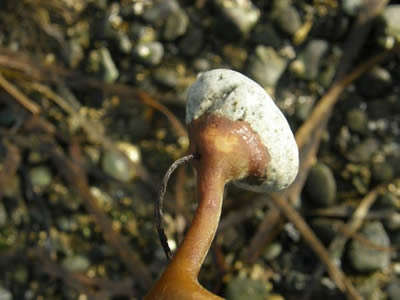 |
Three-ribbed Kelp is easily recognized as the name that identifies it says it all. The image of the right shows the holdfast attached to a small pebble.
The large leaf blades easily drag these small stones up onto the shore when caught in the tide. |
| || |
|
|
 |
Another common brown seaweed found in the cooler waters of the oceans is Sugar Wrack, Laminaria saccharina. It has a large single blade with ridges and depressions that follow the edges. |
| S |
 |
|
 |
Sugar Wrack is divided into three parts: the holdfast; the stalk and the blade (leaf). The blade grows from a usually short, smooth stalk, which is called a stipe (left image). The strong holdfast attaches the seaweed to rocks and shells, sometimes with several occupying the same rock (right image).
Sugar Wrack prefers sheltered areas where its blade does not get
battered by pounding waves. |
| || |
|
|
|
|
| |
| Dereila Nature Inn Home > Lagoon Trail > Marine Life Guides, Articles, Trivia and More! > From the Garden of the Sea |
| |
|
|
|
Home | All Things Natural Restaurant | Bird's Nest Lounge | Cyber Room | Lagoon Trail | Naturalist's Nook | Wildflower Garden | Woodlands Pathway
Site Map | Inbox | FAQs | News and Updates | Newsletter Information | Games Room | Privacy Policy
All content © Dereila and Sage Innovations
|